
Friday, June 12, 2009
The Desert Fathers


St. Michael icon - gold leaf

The border has yet to get its second layer of gold leaf. The rest is all down, and later will look smoother. Two layers of gold leaf altogether. The halo has been burnished; that's how it stands out.
Now, the first layer of gold leaf was laid down using some fish glue mixed with vodka as a binder. Some breathing also went into it. The second layer was done with a more diffuse mixture of the same (plus breathing), but could have been done simply with water and alcohol, which would have acted as a reconstitution of the previous glue underneath. Even the first layer could have been done as such (just water and alcohol and no glue), since there is either animal skin glue, rabbit skin glue, or fish glue in the red bole that was laid down before the gold leaf. Gold leaf is one atom thick. To say gold leaf is finicky is an understatement.
Thursday, June 11, 2009
Brush Care

The other day I went to get some more at the supply store and found the price for the stuff was over nine dollars - just for one container, as pictured. I remember when it was below five. There's no way I'm going to pay that for a puck of soap.
I started looking at the other soaps, and came on this:

A little cheaper and a lot more of it.
Then I used it the same day to clean my brushes. It smells exactly like the soap from the washrooms of my elementary school days. I'm starting to wonder if I'm being snookered. Are these companies just packaging generic soap as "artist's brush cleaning" soaps, and selling it for ten times the price? There's lots of bar soaps and liquid soaps that are especially mild, without strong detergents. Why can't I use those to clean my brushes?
Why not regular liquid dish soap?
I think I will.
Tuesday, June 9, 2009
EDM Challenge #131

For Owen's EDM Challenge #131: Draw a spray bottle.
I took my spray bottle and put it on a small canvas, the bottle on its side. I then spun the spray bottle and figured I would draw it from whatever position it stopped at - you know, to be spontaneous.
So I spun it a few more times before it stopped at the position I wanted.
I'm real spontaneous.
Sunday, June 7, 2009
The Desert Fathers
World's Sexiest Beaches ("News" headline)
I'm disturbed by the possibility that there are people out in the world who, seeing a beautiful beach, a place of certain longings, refreshment, discovery and innocent curiosity, will thereupon say with all sincerity that it's sexy. [First frontiersmen, upon pushing aside the brooms of evergreen and peering out to a previously undiscovered expanse of crystal blue shattering on blinding shores, say with one accord: "That is so sexy".] Sexy? That is like thirty rungs below "neat".
Or would the headline be referring to beaches that are known for prominent immorality, like fornication?
If so, then how is other people having sex on a beach, or committing acts on a beach that lead up sex, or committing thoughts on a beach that lead to sex, sexy?
Knowing that this beach we are standing at the threshold of is home, right now, as we gaze, to other people fornicating or carousing in a manner that is the occasion to fornication? Yeah, real sexy that.
And herein lies the key to what's so disgusting about the mainstream secular culture's pop take on sex: it's public. Lose the secret sacredness (not pagan "sacredness", but the awe-inspiring sacredness that you know is from God), you lose the sexiness. The secular culture is demented and blind enough to take a wide public sort of vista, like a beach, and it's next automatic thought in line is "sex".
Friday, June 5, 2009
Garden Sprawl Friday


The yellow irises came first, then the blue-violet ones. I've always loved the clashing ranks of their green swords on a windy day.

For today's Garden Sprawl, this tale from The Desert Fathers may seem pertinent:
XXIII. There were two brethren, monks, that lived together in a cell, whose humility and patience were the praise of many, even among the Fathers. A certain saintly man, hearing of them, wished to prove if their humility was sincere and perfect: so he came to visit them. They welcomed him joyfully and when the wonted prayers and psalms were ended, he went out of doors and saw a little garden where they grew their vegetables. And he caught up a stick, and set to with all his might to beat and break down the herbs, till not one was left. The brothers saw him but said not a word, nor were their faces vexed or downcast. He came again into the cell, and when Vespers was said, they bowed before him, saying: "If you will suffer it, master, we shall go and cook and eat the cabbage that is left, because this is the time that we have our meal." Then the old man bowed before them, saying: "I thank my God, for that I see the Holy Ghost rest upon you: and I exhort and entreat you, brothers beloved, that ye keep to the end this virtue of holy humility and patience, for it shall be your greatness and glory in heaven in the sight of God."
I'm trying to imagine someone coming along with a stick and trashing all my cabbages - or lettuce,

or various others:

Those two monks were not quietistic phonies, that's for sure. That test was the real thing.
Here are my three lingonberry bushes:


The small one on the left is a wild one, as opposed to the two cultivars on the right. I have found lingonberry hard to come by. But I'm trying to get as many different ones as possible, and plant a good long curving row of them in the front in a raised bed faced with rock.
The lingonberry bush will spread out more by underground rhizomes, but it will only go so far, which is nice. It remains a small compact shrub that is evergreen, and it generally has very polished looking leaves, though the one on the far right (Koralle) has narrower, more lightly coloured leaves and less of a shine.
They put out clusters of tiny, white/pink hanging bell flowers. I've smelled the flowers on the ones I'm growing, and they have an elusive candy smell. I've read that lingonberry is self-fertile but produces far more berries when cross-pollinated with another cultivar. Hence my wanting to get many sorts of them. Pollination is by bees.
The lingonberry has a long tradition in various cultures, like with the natives of my province, but most familiarly in Scandinavian culture. It is like a cranberry but pea-size; but unlike the pucker-inducing, out-of-hand cranberry it has more sugar even than the blueberry, but equal acid as the cranberry. This means that the lingonberry is still tart, but far more edible out of hand, especially at peak ripeness. I understand it has a real wonderful tang.
Of course, it is one of those plants us northerners can gloat in that can't be grown very far south where it doesn't get cool often enough, and where the warmth is too consistently warm for it. But where I live, one can also grow these:
Fig trees. This one is a Desert King, the prime fig tree (of the select few that can be grown here) for southern B.C. I'm debating how I should grow it; as a multi-stemmed shrub or standard tree; in the ground, or in some kind of rock pot.
One can also, if one does it right and in the right climactic zones, grow kiwifruit. We have a very unique climate. Very good for berry-growing.
This is what I love about oak trees:
The old dead leaves still cling to the tree when the new leaves come out. There's something about it that I like.
As a bit of follow up to last Friday's post on herbs, here's some mountain mint, starting to flower:

Here's some Hyssop:
Yarrow:
There's this house in the town where I live. An old couple lives in it, and every year they grow a lot of vegetables (and fruit by the looks of the trees) on their property.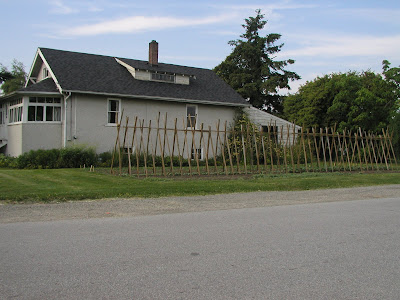


This year I finally saw them when they were working the dirt. There was an old man doing what he could in a wheelchair; an old lady looking on, and another old man standing and wielding a hoe as though he was barely able to lift it. Yet they grow tons of stuff. I imagine their pantry must be loaded with canned goods from down the years.
Annually seeing their garden(s) grow is one of the few humble, pleasant sights to see in this town, which seems to be changing for the worse [Man shot dead in the bathroom of the strip bar a few weeks ago, across from which is now a tattoo/piercing studio, and down the street from them, one of those high end Harley bike shops. They're all one sub-culture.] - for the worse, of course, in tandem with the million dollar rejuvenation/upgrade/facelift of the main area that many generations ago was the hub for the entire province.
But back to my own garden. The temperature here has been steadily in the high 20's, pushing into mid 30's (that's celsius) without rain or cloud. Just last Saturday I planted my beans:


and pumpkins,

and the Thursday and Friday before that Saturday, I planted the beets:

I thought I wasn't going to bother with melons this year, but I was at a nursery waiting in line and some packets nearby caught my attention. They are Minnesota Midget, a muskmelon, or what we falsely call cantaloupe. I'm growing them in two large containers, as theses ones are not prone to spreading very far. The melons are small but tasty, and quick to mature; perfect for northen climates.

Gift and Given Over
beside us. But legs and muzzle exhaust, they passed
as shades, whose hooves made of the ever-earth floor
a hollow drum, pacing behind the shifting firs.
Then one showed through an opening between the trees,
came out black and slick as the rained upon asphalt:
Still bystander at the wire fence and nettle,
shaking out its thunderous snorting breath
upon the field's limits and into our hearing,
before going back to the other horse
and the hidden vastness. But while it lingered,
looking without inquisition on our work,
a thousand other creatures' blithesome presences -
the frogs that pounce on silent blades, the spiders;
the worms elastically jigging beneath, and more -
woke like many raindrops, that all at gust once, upon
the trees, spatter, soak, breaking into down-way courses.
And then the presence of long-back, ever before:
one meanwhile moment that is ancient and assures
that not a soul will volley into self all self
without world-field's fence eating, edge enveloping,
dismissing our forensics of the world's trial
we bring forth to show, that are then deemed to be no worth;
always our way displaced with wayside proven larger;
no one exempt from being given gift and given over,
while each is born in the midst of a million births.
Sunday, May 31, 2009
O
From Live Your Best Life Ever!, a Newsweek article by Weston Kosova and Pat Wingert, May 30, 2009
Clockwork
The Old Dragon runs a tight ship.
Too tight.
Saturday, May 30, 2009
On the eve of Pentecost...
"How to kill aphids"
Since I found some aphids on a few plants of mine today, I was wanting to get the exact measures for liquid soap and vegetable oil to use in water.
You know how Google throws down its scroll now with a list of things that people search for that might be what you're looking for. As I was typing, How to kill...Google throws down a list and on the top of the list is:
"How to kill yourself" 21, 700, 000 results.
and another:
"How to kill a person" 79, 600, 000 results.
another:
"How to kill someone" 20, 800, 000 results.
We can look at this full-square in the face.
We can, because the descent of the Holy Spirit ensures that we can plumb the depths of the world's misery without flinching, with a bold and scanning eye, and proclaim truly that the world is sadder, deeply sadder than we know.
And then with an interior movement that is like the hurled gyrations of the discus thrower, and which feels like the holocaust of our own selves, we turn to the mighty renewal at hand, coming like a coruscating sun from under an unknown horizon; a renewal whose one and only commonality with our misery is that it is also beyond all fathoming.
Friday, May 29, 2009
Garden Sprawl Friday
 The swallows are back. Sheesh, they love to chatter.

The potato plants are putting out their buds. Time to keep them watered.
***
I would like to make a good analogy for the use of planting herbs around one's garden, like: "Herbs are to your garden what something is to something"; but I can't think of any, so there it is.
Herbs are not essential to your garden per say; you could grow crops without them. But I can only make that statement because the relationships of diverse flora do not operate under terms of "essential" or "useful" or "beneficial". The aim should not be what you can do without, but how much you can include. How much flora can you get in around your gardening space and landscape (without turning it into a haphazard jungle of course; modesty and sparing does fix into this), while at the same time considering use of space, light, companion planting, aesthetics and so forth. This brings me to the point I wanted to make about really successful gardening: you need to have so much going on that whatever failures may occur, they will not spell Total Failure.
A garden ought to be made to develop a rhythm of its own; a flurry of interchanging and limitless propositions that relieves the gardener of the utilitarian approach. With all of the gardener's new trials and experiments, there ought to be a concomitant drive towards permanence for those trials and experiments to take place in, as one builds up the space one has. The prominent term for this is permaculture, which seeks to create an environment that is basically its own mini eco/climate system, rather than merely a bed that one plants with one kind of crop one year, another kind another year, and nothing much else going on besides.
It seeks to include everything. It wants birds and butterflies and flies and bees. It wants moisture retention and shade in the right places and rocks and shrubs and trees. It wants every nook and cranny incorporated in the whole. The gist is that the more seemingly unrelated flora you grow around each other, the more you have a protected home for your crops; and things need a home to thrive. Even the big monoculture fields need to utilize trees along the edges of fields to protect from winds eroding the soil and damaging crops.
There are many things that go into making this; and all of it is, to my mind, mere common sense, carried through to its mad, joyful conclusion of simply doing it, according to one's dreaming, thinking, and sane encounter with what is at one's disposal. I would rather call permaculture Sprawl, but for the sake of this post I will call it permaculture.
This is nothing new. People in the old days had at least some kind of grasp of it, having profuse borders of crowded herbs and flowers; a corner occupied with a tree; rocks placed so as to create a heat sink, or alternatively a cool place for storage.
When seeking permaculture, herbs are a good place to start. One question is how vigorous and invasive are the herbs you want to plant and how much and what kind of space do you have. Adjust accordingly. Be shrewd. You can fit herbs in the tightest corners. Thyme thrives in bad soil; it hates rich soil; perfect for rocky ground and in between rocks. Worried about certain herbs, like mints, naturalizing a little too much and taking over? Devise a "half in the ground/half potted" system around borders using brick or rock, forming a bowl in the ground and planting in there. This can allow for easy pull-up for root pruning and replanting; it's both permanent and controllable.
Some herbs I'm growing, mostly from seed, some from store bought plants:
Mountain mint.
Korean mint.
Peppermint.
Cat mint.
Thyme.
Sage.
Greek oregano.
Winter savory.
Tarragon.
Goldenrod.
Yarrow.
Hyssop.
Bee balm.
Lemon balm.
The fact is, having herbs around your garden is indispensable. There are some, like yarrow, that merely being beside other crops helps them to grow better and taste better. Some confuse pests that detect your crops through smell. Some repel pests. Most do all these things together, as well as attracting beneficial insects. Many can be ruthlessly harvested for mulch and "green manure", and they'll spring right back again. Often the most common ones, stuff you see growing in roadside ditches, like yarrow, are the best all round ones.
And call me crazy, but I noticed when I placed all those mints in and around the cabbages, it was like the cabbages just got real perky. You can just tell that the cabbage loves having the mint around.

Sunday, May 24, 2009

Saturday, May 23, 2009
By Wayside and High Spire
shares in the world of bells;
for sky-large sound, fainted smells.
Along some woven paths,
in the quiet-down of dusk,
meek starlight in the underbrush
releases little scents:
the wood's twice hidden flowers.
(Once by size, then by mingled towers;
then the fragrance given-
if sought- is the thrice thing hidden.)
And what but air-carried clang-ridden
swing of bells should match them?
Each pouring out what bees and souls
hone back to a source: one faints; one tolls.
But now few bells are swung;
and the wood's profuse with blooms.
And their scents, spun from ageless looms,
are still quaintly, faintly flung.
Friday, May 22, 2009
Garden Sprawl Friday


This is what the backyard soil looks like here without being amended. Once it has been in the sun as pictured it can look deceiving. Put a shovel down in there and you'll turn up quite black, heavy, alkaline soil. Beneath that, about a foot and a half down, you get the straight grey clay. I dug this patch by hand down to where the two feet of clay starts to give way to something else beneath it. It's like your hitting hidden springs. At some points I noticed beneath the grey clay there is a stratum of extremely black, beautiful silt, some even with as yet-not-decomposed dead grass and wood in it. I guess under all that clay no air can reach, and thus no decomposition.
Anyhow I dug down that far simply to bury the turf I peeled off of the surface. I threw a bunch of compost in as well, digging in sections, then burying it, then digging up another section and so on. [I don't have a backhoe or a rototiller] Useless labour? Bah; how else does a garden get blessed? So, as you can see there's now lots of the pure clay brought to the surface, broken up. This will be amended over time, to which end I will go to the beach and harvest lots sea weed. In autumn the obligatory leaves will go in; throughout summer, lawn clippings (we don't use any chemicals on the lawn, so it's fine to use them).
Oh, and there was lots of rocks; wonderful rocks that can be used in landscaping.
Cucumbers and pumpkins and sunflowers will go in here. I'm just sort of regarding it right now as 'the fun patch', since it wasn't really planned; I just started digging it up.


The ever-reliable, first-to-pry radish. Even radishes require a bit of vigilance. If I had simply gone outside one night (when the slugs come out, especially after or during rain) and skewered the bastards - instead of skewering (and salting) them one night later - then some of the radishes' root tops would not have been chewed away.

Nonetheless, even those you can still use, just cutting off the eaten portions a bit below the chewed sections. I've heard things about snails and slugs carrying bacteria, so I would make sure to cut well below the eaten parts, though at the same time not waste any.

These radishes are an heirloom variety, called French Breakfast. If I had left these in the ground a bit longer (which I would have were the tops not eaten by slugs) the radishes would have actually been longer yet, with more blunted tips, and a greater portion red, tapering off to the white.
As far as radishes go, they taste good. They're milder than your usual radish. Though they are still radishes. The only thing radish goes well with is salt.
Getting back to those slugs. I've noticed a less pervasive presence of them this year. By the way, where I live is slug central. Up through Oregon, on through Washington, into British Columbia: slug central - at least the parts near the coast.
Big ones. You'll be walking through the woods on a wet day and: hey ho- watch out for that big piece of dog crap - oh wait, that's a slug…
I've been trying different methods. I will list them. First, you can't beat simply killing them when you see them; taking just a few minutes at night to go out and kill them as you see them. Second, there is copper. Copper stripping, copper wire, copper: it causes some kind of electric shock to slugs. It really does. I tried it. That slug went off of the copper strip as fast as you'll ever see a slug move - which was still pretty slow, but you get the picture. Problem with copper is the cost; but if you have coils of copper wire you can use it, like a border around whatever you want protected. Third, coffee grounds. Coffee grounds are by no means a mighty slug killer, but more like slug prevention. In fact, I think, and intuit, and observe, that coffee grounds are just a real good all round pest deterrent. I should emphasize: it is not full-proof, but it certainly does something. Ask yourself: who likes the smell of old coffee grounds? I know I'm not terribly deterred by the smell; I actually kind of like it. But really, no animal or insect is going to be attracted by the smell - though I've heard fruit flies can hover around them. I scattered many used grounds inside the small greenhouse late winter/early spring. Once that sun starts pounding into the greenhouse you can bet the smell of old coffee grounds fills it like you wouldn't believe. I have read that the caffeine in the grounds will poison slugs or any other creep-crawly dumb enough to eat it. But that's the other thing. You do have to be careful about what you put the coffee grounds around, if you decide to use them. I have raised beds, and I scatter them also around the outside of the beds. I would not put it among the crops I grow. I understand that there are select plants that like having coffee grounds in their soil - rhododendrons, azaleas, blueberries, lilies - but not all acid-loving plants like coffee grounds. If you don't drink coffee and want to use coffee grounds, or if you do drink coffee and want more coffee grounds, go to a Starbucks and ask them for theirs. They should oblige you with big bags of the stuff for free - lots of them. They overprice their unused grounds, but the used ones are free.
Where was I? Slugs. Number four: slug bait; the kind you buy at the nursery. It goes without saying, if you have dogs or cats, do your research before laying the stuff out. There are chemically harmful ones, and ones that are safe to use, including around plants; though I still would not use the safe stuff on the same soil as edible crops. Does the slug bait work? Hell yes it does.
Five: I haven't tried the beer method. The money that could go into purchasing cheap beer could be used instead to buy good beer that I would drink. Never used it; probably never will. Besides, you can make the same trap using yeast/sugar water. There are simple recipes out there.
On to other things. The Nordmann fir seeds, the ones that I did a post on last year, found right here, have been exciting to watch do their thing:


Here are some beach strawberries growing from seed that I planted last year. Keeping an eye on the wee guys (they were quite smaller than pictured here at their latest) through winter was a little strenuous. [Are they really going to make it? I can't believe they're still green…]

The plants will get larger and produce small strawberries, unlike the ones we see at the market. But their taste is ten times better. This strawberry actually was one of the ones that went into making the hybrid we buy at the market.
Now I could easily buy these same strawberry plants from a nursery, fully grown, and get berries sooner. But from seed is better. Why? Because whenever you grow something from seed, you are "imprinting" on that plant, from its embryo stage on, the gist of your regional climate and conditions. It thereby becomes more resistant to certain diseases and does not require any adjusting stage, which stresses a plant.
From seed is also the 100% guarantee that you are not bringing diseases to your neck of the woods from the nursery - or from the place the stuff grew at before it came to the nursery. Plants are grown to sell, and they are grown under the most "favourable" conditions, that is, greenhouses that are monitored for temperature control, dryness and humidity. Where profit is concerned, you do not have the time to start everything from seed and grow it slowly, slowly under more natural conditions. It is grafting, cuttings, tissue culture, and favourable conditions.
There's nothing wrong with grafting, cuttings, and tissue culture per say. But there is a reason why so many species produce seed - and produce so much of it. There's something even to still be learned, I think, from species that produce seed that "reverts" when germinated, or doesn't come true to type. After all, isn't that the process from which all our varieties of apple came from, or has as its foundation?
That long, rambling, rollicking process by which the fruits we take for granted came about has been largely forgotten.
It is obvious, I think, that we have strayed away from the obvious: the key to "improving", or honing a fruit or crop - which is something I believe God left in His creation for the participation of man - is found not in cold genetics. It is found by submitting in wonder to the process itself by which species reproduce.
We make the symphony better, not by rewriting the score, nor in fact by trying to make it "better", but by hearkening to it and giving ourselves over to it in worship of its composer, whose creation does not require the utility of our improvements, yet is wholly open to the otherness of further creation by our joining in as His creatures. It is within that submission that our craft produces the unforeseen yet deeply desired fruit.
Next week on Garden Sprawl Friday: I don't know.
Thursday, May 21, 2009
Out of Bed

Today was largely regaining strength; and there's still a bit of sinus congestion.
But the worst thing about illness like this is the mental stuff. What you do with your mind as you lay there tossing and turning or trying not to toss and turn; as the light you saw rise through the blinds at morning slowly goes dim again and into another long night. We always like to think that when things come down to the nitty-gritty we will have the grace in us to pray through whatever it may be. Sure, we do, but the grace doesn’t look like we think it would. The grand heroic pain-offering, like some final symphonic crescendo; the theatrical interior orans of the soul going up to God, having crossed the threshold of pain to ecstasy...is simply not there. If one chooses, if one even remembers, it is given up in the most feeble, inarticulate manner - and even then, in retrospect, tranquility and abandon were sorely lacking, and as for praying continuously…yeah, right.
You don't have recourse to the faculty of imagination in its healthy state. The imagination becomes the prey of insanity. Really, what were those insane half-dreams I had that caused literal pain, that wouldn't stop?
I'm not complaining, nor, I hope, being self-indulgent; just trying to write about stuff, and say that one learns. I got up this morning and fed my growling stomach with delicious granola cereal, half a mango and tea; went and looked at the garden; went and picked up some picture hanging wire (painting goes to the judges tomorrow evening); pulled up the first humble radishes before supper.
The Voice of Saruman
"Those who listened unwarily to that voice could seldom report the words that they heard; and if they did, they wondered, for little power remained in them. Mostly they remembered only that it was a delight to hear the voice speaking, all that it said seemed wise and reasonable, and desire awoke in them by swift agreement to seem wise themselves. When others spoke they seemed harsh and uncouth by contrast; and if they gainsaid the voice, anger was kindled in the hearts of those under the spell. For some the spell lasted only while the voice spoke to them, and when it spake to another they smiled, as men do who see through a juggler’s trick while others gape at it. For many the sound of the voice alone was enough to hold them enthralled; but for those whom it conquered the spell endured when they were far away, and ever they heard that soft voice whispering and urging them. But none were unmoved; none rejected its pleas and its commands without an effort of mind and will, so long as its master had control of it." --J.R.R. Tolkien