"It will happen," he [Richard Donner] assures fans. "We've been trying for a number of years."
They reunited - again.
Did you hear that, E?

Tuesday, June 8, 2010


Monday, June 7, 2010
Nice Tux
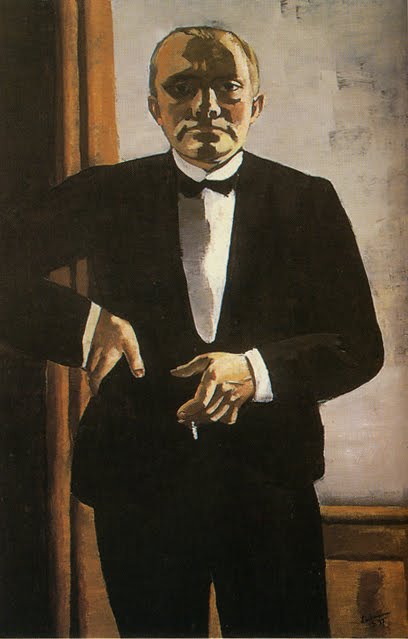
"Soul, self; come, poor Jackself, I do advise
You, jaded, let be; call off thoughts awhile..."
---
Painting: by Max Beckmann, Self-Portrait in Tuxedo
Lines from one of Gerard Manley Hopkins' Dark Sonnets
Lines from one of Gerard Manley Hopkins' Dark Sonnets
---
Saturday, June 5, 2010
"Beg the Holy Spirit to help you to understand the Eucharist"
I was very moved by this story at Da Mihi Animas.
Jesus' admonition that "you cannot serve two masters" has a way, as with all His admonitions, of dawning on one anew as though one had never heard it before. This dawning can come through the results of sin and also so often comes with Eucharistic awareness, that is, a new awareness of His true presence.
No longer do the words in such case sound like a teaching moment, easily understood yet still abstract, but become a solid interjection in the momentum of your life - albeit an unforced interjection. The presence of Jesus among us under the species of bread and wine is one that must finally become for us our sole inestimable treasure, and not just one presence among many.
The miraculous banquet of the Unfathomable Other must be woven into the regular stream of our life; but then that diffusion, the incarnation of Jesus and His most intimate working in our souls, must be remembered as, and brought back to, the miraculous banquet of the Unfathomable Other again (that our selves not become our ends) - the banquet that can restore a burned infant with new skin and cause a thousand people to give pure praise in the midst of a garbage dump (see story above).
How often devotion gets in the way! (Or, ahem, liturgical talk) For it seems to me that people like to say of others who go steadily to Adoration and daily Mass that they are very devoted, devout; and they say this as a means of dulling the efficaciousness of that person's practises from infesting the regularity (or secularity) of their own lives. (If you're "devout", then I'm safe - from you.)
The great burning question that still faces us who don't live in garbage dumps remains this one: where does your treasure lie? For there also is your heart. When Jesus said that between the two masters you will end up loving one and hating the other, there was also the obvious implication that you will end up cleaving to one and severing ties with the other - a natural outcome.
Friday, June 4, 2010
Garden Sprawl Friday
The greenhouse, half-filled with tall, leggy lettuces and cabbages mixed with equally tall weeds, mocks me, and the slugs have broken me down - as has the persistent rain. I slacked off the past weeks in going out every night to exterminate. The rain has made the grass grow fast and thick (and no chance to mow it), thereby providing sanctuary for the slugs. I haven't cleaned up the old pots, pieces of wood and other miscellania that needs to be thrown out, further exacerbating the problem.
I had thirty melon sprouts up in the greenhouse. Slugs took down close to ten. I sowed three and a half packs of three varieties of beets in the front bed. They were coming up wonderfully. The slugs have mowed them down like they were M&M's. I sowed two kinds of carrots. They were coming up; the slugs took them all down.
This is also due to my fault in not paying attention to the weather. The rain brings on the slugs. I didn't need to sow the beets so early; I was following what a book said. You really have to wait patterns out. Plants can miraculously make up for the "lost time": if they get the perfect warm start they can grow faster and more vigorously than something planted early that had to slog it through cool wetness.
So I've decided not to grow beets, and where the beet seedlings got eaten, there I'm going to plant all the crap from the greenhouse. The pole beans and pumpkins have been lingering in the back of my mind as to where they are going to go.
At this point I've learned simply not to plan it yet, but just deciding that I will plant them is good enough for now.

Wednesday, June 2, 2010
They look to spoil everything
June 11th. will indeed be a dark day in the world of film.
The only articulation I can come up with thus far is nest-robbing, dream-gobbling, money-licking, marrow-sucking sons of bitches.
Because that is what sputtering rage does; it causes one to be at a loss for words, as seen here:
The only articulation I can come up with thus far is nest-robbing, dream-gobbling, money-licking, marrow-sucking sons of bitches.
Because that is what sputtering rage does; it causes one to be at a loss for words, as seen here:
Pray Against the News
Having recourse to prayer amid escalating devastations has been besmirched in our minds as a fool's last desperate measure; and more, a fool's giving up; and further, a fool's past neglect in prayer now being remedied, too late, for selfish reasons.
The above quantification only goes so far as a sign of how much credit and trust we are willing to give to prayer itself and the diminution we are willing to give to the media's importance (and all the world characters portrayed therein).
If we regard prayer as just the means of getting a solution, only after our trust in man has failed, then it is perhaps an imperfect prayer. But what if the prayer, the trust that goes into it, is fueled more and more, increased in proportion to the rise in chaos and fear, indeed, increased to the apparent silence one receives in return - when one gets to the point of forking over radical trust where one has never really done so before, and at that, with joy and gratitude?
It is then that even the latest, too-late prayer extends back into the past and becomes the literal prayer of your entire life, your entire being; not your entire being as some emotive collection of your present faculties, but of the being of you that has been in time since conception - you on the swing-set, you stealing some candy, you at a party. It is not something that needs to be imagined; it is already there when we pray. All of one's life, every breathing minute in time past, now being prayed and now all real. (This is obviously not something summoned through one's own powers, for it has nothing to do with one's own powers.) If "love covers a multitude of sins", then think about what prayer covers.
Then one can accept the thought, without a hint of presumption, that it is never too late to repent, and therefore never too late for the world to be completely turned around.
It is to be wondered, whether the ever-present News is nothing more than an ever-deepening, insinuating distraction away from the strongest solution that has been at our disposal since the beginning - prayer.
To be wondered, because there is the subtlest temptation that comes with every single little bit of information we receive through the media. I am not referring to despair, but to something like a horrible blasphemy. The temptation is to be prodded into a kind of awareness that is in fact an insistence on greater separation from God: as our colossal failures and offences stare us in the face through all kinds of unexpected disasters, we do not merely cling to our ways, but increase the arrogance of our ways. It is not a loud arrogance, but a steady, silent one, wearing the face of care.
We have been deceived into thinking we are just reading, or hearing, or seeing facts and events when we heed the News. I refer not to media lies and deception, but to the initial fact of what the News is. To watch the News without detachment is to pretend that you are connecting with facts and events around the world through a channel that is completely inadequate to even the beginning of such a connection. And often the major event that has occurred is the unperceived alteration in one's own mind.
Prayer connects us with our entire past life, in a way that frees us, as our entire being prays in the present; we are ushered into reality. The News - deceptions and spin, agendas and biases aside - the News, just by dint of what it is, ushers us into a dream world.
Monday, May 31, 2010
Sunday, May 30, 2010
Saturday, May 29, 2010
Locus Focus - A Remote Valley

 (Update: I overlooked something so have removed unnecessary excuse-making)
For this Locus Focus I took Hills and the Sea down from the shelf.
The essays are generally concerned with the places that Hilaire Belloc, the writer of the essays, travelled. As the title suggests, each essay is vitally connected to a concrete place - the inspiration for each essay deriving from them, though not every essay is solely about the place.
Belloc's portrayal of these settings almost always goes into the mythical, whimsical and the fantastic (not to mention the historical, the political and the philosophical). The places that Belloc describes therein are vividly envisioned and become places the reader would like to, or wouldn't mind, visiting and exploring (preferably back in 1906).
At first I thought I would randomly pick a title from the index and go with that one, since I haven't read this collection for a while. But I read through a few essays. Now, I could go into the essay that talks about a town whose entirely unique, present-day layout was developed over time by the negative spaces that drying fish nets happened to make as they were haphazardly laid out on the ground - the buildings slowly growing over the centuries between and around the placement of the drying fish nets. A town born of its trade if there ever was one.
But the essay that reclaimed my attention was one called, The Mowing of a Field. Belloc is here returning to some place of his childhood. The essay begins:
There is a valley in South England remote from ambition and from fear, where the passage of strangers is rare and unperceived, and where the scent of the grass in summer is breathed only by those who are native to that unvisited land.Belloc the cosmopolitan was big on non-cosmopolitan places. He continues:
The roads to the Channel do not traverse it; they choose upon either side easier passes over the range. One track alone leads up through it to the hills, and this is changeable...The woods grow steep above the slopes; they reach sometimes the very summit of the heights, or, when they cannot attain them, fill in and clothe the combes. And, in between, along the floor of the valley, deep pastures and their silence are bordered by lawns of chalky grass and the small yew trees of the Downs.Belloc has returned to this place in late evening. The next morning he wakes up:
The clouds that visit its sky reveal themselves beyond the one great rise, and sail, white and enormous, to the other, and sink beyond that other. But the plains above which they have travelled and the Weald to which they go, the people of the valley cannot see and hardly recall. The wind, when it reaches such fields, is no longer a gale from the salt, but fruitful and soft, an inland breeze; and those whose blood was nourished here feel in that wind the fruitfulness of our orchards and all the life that all things draw from the air.
In this place, when I was a boy, I pushed through a fringe of beeches that made a complete screen between me and the world, and I came to a glade called No Man's Land. I climbed beyond it, and I was surprised and glad, because from the ridge of that glade I saw the sea. To this place very lately I returned.
…before it was yet broad day, I awoke, and thought of mowing. The birds were already chattering in the trees beside my window, all except the nightingale, which had left and flown away to the Weald, where he sings all summer by day as well as by night in the oaks and hazel spinneys…The birds and the thought of mowing had awakened me, and I went down the stairs and along the stone floors to where I could find a scythe; and when I took it from its nail, I remembered how, fourteen years ago, I had last gone out with my scythe, just so, into the fields at morning. In between that day and this were many things, cities and armies, and a confusion of books, mountains and the desert, and horrible great breadths of sea.The author describes in detail the proper way of sharpening a scythe. He then describes the proper way of mowing the grass, and the proper time to do it. He has many swathes already cut before the time for the Angelus. Later, a man comes to help him for a wage. Belloc brings out some small ale for them to drink, and later some lunch…
Evening comes. The entire two acres are finished and the two men agree to meet again next morning to gather up the swathes.
One could venture to this nurturing, balmy place just to do the simple things Belloc did there, or else one feels he could go there to die.
Friday, May 28, 2010
Deliver. Sign name. Await reply.
Today is the date for delivering works to the art gallery for judging tomorrow. I dropped two paintings off this afternoon with something like a breeze of indifference. After almost ten years of entering work and being rejected, with the exception of one year (and the exception of other exhibitions), one begins to see how pathetic it can be. The most pathetic though are the artists who change their work to the likeness of those works that get accepted and prized.
Yet no amount of detachment spares one the hurt of going to the gallery and finding your pieces have been rejected. It's a healthy hurt - if you take it right.
Awhile back, there was this other competition and exhibition held locally, where the rodeo and fair is held every May long weekend (Victoria Day). It was a western themed exhibition, to be held during the fair and rodeo. I entered a landscape; a local landscape. I also volunteered to help receive the entries; to help move them around. There were a lot of entries. The large hall which held them was lined all the way around with paintings and drawings.
Helping to line up the paintings, of course I got to see them all, and felt mine to be like a scrappy little ruffian at a cocktail party. I remember one couple who had entered pieces. They were going along looking at the works, and they made snarky remarks about some of them, and I remember wondering what sort of nasty things they would say once they got to mine.
That was the morning, and the judges were going to come in the afternoon. Of course, no artists can be around when the judging takes place, so I went home. The entrants were to come back late in the afternoon to pick up their work and see if they were accepted or not. I got back down there a little early; the judges were still deciding. I loitered around the outside and smoked a mischievous cigarette. Of course, I was there to help again with getting the works of art back to the artists.
I was standing in the door to the hall and saw the judges sitting around a table, and one of them kept pointing in the direction that my painting was. I didn't think in the least she was pointing at mine. They were coming to a final decision, engaged in discussion; then they all got up and went over in the same direction she was pointing earlier; and I saw in complete bafflement that they were gathered around my painting.
One of the ladies at the table to receive paintings and keep records started talking with the judges, and she came back towards me holding up her index finger to signal: number one.
If I said that I didn't take delight in what just happened, I would be a liar. I was elated; I was shocked; not in the faintest had I thought my painting would even make it into the exhibition, let alone get first place. It was like a grace of God swooped down from on high and did it as if to say, "There are some graceful things in this painting. Keep going."
And I'll never forget the week after, at the end of the May long weekend, when I went to pick up my painting from the exhibition. I went into the hall, now filled with all manner of booths and tables; companies getting their names out there and selling stuff. The place was packed to the teeth, with people and artifacts. When I came to my painting, it was hanging there like a lost thing, completely forsaken. It looked like a dull piece of crap.
I always sort of have that dichotomy in the back of my mind; that dichotomy between Prize Number One and that day picking up the painting. Each day is a new creation and our works will have about them something that - though the work has savour in relation to a whole - is limited in more or less degrees. No one is exempt.
I remember reading Flannery O' Connor stories back-to-back over a stretch, and around the tenth or so story her infiltrating Grace started to look like a cheap parlor trick.
Take a hard look at Michelangelo's figures on the Sistine Chapel or on its altar wall. Lose sight of the whole, and narrow in on the singular anatomy, and you see that no one is exempt from this limitation.
You think you'll be the most conscientious and not fall into the same failings? Alright, the Muse says, wish granted: your work now stands before you, without light, utterly square and hopelessly pedantic.
This is an incentive that should free us, and not be a cause for cynicism. For what is most amazing is this: all that is so fickle in us and in our works is hardwired by a very direct connection to our eternal longing for the Permanent.
The Buddhist likes to meditate on impermanence - a noble thing: let's not be fickle. But what is it in one that is meditating on impermanence?
Keep going.
Monday, May 24, 2010
A few 300 notes
--I don't know why I waited so long to watch this film. Well, actually I do. From the trailer, the film just seemed evil and loud; loud visually and sonically. The heavy metal didn't help. I didn't expect to like it, which is a good way to approach any film.
--Strange, that a film so rife with gratuitous nudity, sexuality and grotesquery should be one of the most morally sound, not to mention morally appealing films I have watched for a while. But those excesses, which are not merely 'excesses' but something profoundly at odds with modesty: typical graphic novel adolescence. They are not present in the film merely as those universal elements to be found in all great stories. And they are too enduring and indulgent to recommend the film.
--The film is not just 'comic book' in its visual effects, but in its gliding over the typical cinematic build-up to battle scenes. In regards to structure the film is nothing. But it's meant to be flipped through, like a comic book.
--I liked how the film pumps up the wiles of the Persians: tyranny wearing the mask of arbiter, making pleas for peace and the promise of shared power. All the while, their evil and hidden intentions, and uh, ugliness, are plain for all to see.
--My favourite line from the film: "Haven't you noticed? We've been sharing our culture with you all morning."
--Other favourites: "The old ones say we Spartans are descended from Hercules himself. Bold Leonidas gives testament to our bloodline. His roar is long and loud."
and,
"This day, we rescue a world from mysticism and tyranny and usher in a future brighter than anything we can imagine."
Sheeeeeeeit. If My Big Fat Greek Wedding failed to make you want to be Greek, then those moments in 300 should prove the ticket.
Saturday, May 22, 2010
Locus Focus - A home where there are none
Link up, share and read about the settings and worlds in books
"It was already very dense twilight when we struck southward from Purley. Suburbs and things on the London border may be, in most cases, commonplace and comfortable. But if ever by any chance they really are empty solitudes they are to the human spirit more desolate and dehumanized than any Yorkshire moors or Highland hills, because the suddenness with which the traveller drops into that silence has something about it as of evil elfland. It seems to be one of the ragged suburbs of the cosmos half-forgotten by God - such a place was Buxton Common, near Purley."
This Saturday's Locus Focus looks for a memorable (and recently remembered) setting in an early, obscure collection of short stories written by G.K. Chesterton and published in 1905, called, The Club of Queer Trades.
 The six stories, making a slim volume easily read in one day, are narrated by Charles Swinburne, as he follows Basil Grant (former judge gone mad at the bench, now eccentric mystic and somewhat hermetic sleuth living mostly in his attic) and his more practical brother, Rupert Grant, private eye.
The trio is always happening upon inexplicable, often nightmarish mysteries that are inevitably discovered to have The Club of Queer Trades behind them.
This book is a gem. It is an early, crackling concentration (and portending) of many later Chesterton books: Father Brown, Manalive, The Four Faultless Felons, and there's even the air of The Man Who was Thursday in it - not to mention Dickens' The Pickwick Papers.
Before getting to the setting (nice rhyme eh?) in the fourth chapter (or fourth story), some light should be shed on what The Club of Queer Trades is:
"The nature of this society, such as we afterwards discovered it to be, is soon and simply told. It is an eccentric and Bohemian Club, of which the absolute condition of membership lies in this, that the candidate must have invented the method by which he earns his living. It must be an entirely new trade. The exact definition of this requirement is given in the two principal rules. First, it must not be a mere application or variation of an existing trade. Thus, for instance, the Club would not admit an insurance agent simply because instead of insuring men's furniture against being burnt in a fire, he insured, let us say, their trousers against being torn by a mad dog. The principle…is the same. Secondly, the trade must be a genuine commercial source of income, the support of its inventor. Thus the Club would not receive a man simply because he chose to pass his days collecting broken sardine tins, [LOL!] unless he could drive a roaring trade in them. Professor Chick made that quite clear. And when one remembers what Professor Chick's own new trade was, one doesn't know whether to laugh or cry.
"The discovery of this strange society was a curiously refreshing thing; to realize that there were ten new trades in the world was like looking at the first ship or the first plough. It made a man feel what he should feel, that he was still in the childhood of the world."
It is so good to return to this book! Each story is like a poem.
The Singular Speculation of the House-Agent is Chapter IV, and has the Grant brothers and Swinburne getting to the bottom (or shall we say top?) of an adventurous character named Lieutenant Drummond Keith, "…a man about whom conversation always burst like a thunderstorm the moment he left the room."
After Keith nonchalantly borrows a hundred pound cheque from Basil, both Rupert's and Charles' suspicions are aroused, in addition to the many other attributes about Keith's character. And they all go along with Keith to see whether this house-agent exists, of which Keith said was the purpose for the borrowed money.
The conversation between Keith and the house-agent seems coded and very evasive in front of the suspicious Charles and the far more suspicious and vehement Rupert, while the sleepy Basil seems unperturbed.
The next morning, as Rupert is having breakfast with Basil and Charles, a constable shows up at their door asking about this Lieutenant Keith, because it is apparent he gave the constable a false address after getting into a big street fight the previous night with five other people...
"'It was very simple, sir,' said the policeman, chuckling. 'The place he named was a well-known common quite near London, and our people were down there this morning before any of you were awake. And there's no such house. In fact, there are hardly any houses at all. Though it is so near London, it's a blank moor with hardly five trees on it, to say nothing of Christians. Oh, no, sir, the address was a fraud right enough. He was a clever rascal, and chose one of those scraps of lost England that people know nothing about. Nobody could say off-hand that there was not a particular house dropped somewhere about the heath. But as a fact, there isn't.'"Basil, the mystic, decides he's going to go to the address himself.
"'Get down to that place?' I repeated blankly. 'Get down to what place?'Without spoiling anything (though that may be too late at this point) they do find the Lieutenant (and his invisible home), as he greets Rupert and Charles:
"'You don't seriously mean,' cried Rupert, who had been staring in a sort of confusion of emotions. 'You don't mean that you want to go to Buxton Common, do you? You can’t mean that!'
'Why shouldn't I go to Buxton Common?' asked Basil, smiling.
'Why should you?' said his brother…
'To find our friend, the lieutenant, of course, ' said Basil Grant. 'I thought you wanted to find him?'
Rupert broke a branch brutally from the plant and flung it impatiently on the floor. 'And in order to find him, ' he said, 'you suggest the admirable expedient of going to the only place on the habitable earth where we know he can't be.'. . .
Rupert ran after him with a considerable flurry of rationality.
'My dear chap, ' he cried, 'do you really mean that you see any good in going down to this ridiculous scrub, where there is nothing but beaten tracks and a few twisted trees, simply because it was the first place that came into a rowdy lieutenant's head when he wanted to give a lying reference in a scrape?'. . .
. . .There was certainly a sort of grey futility in the landscape itself. But it was enormously increased by the sense of grey futility in our expedition. The tracts of grey turf looked useless, the occasional wind-stricken trees looked useless, but we, the human beings, more useless than the hopeless turf or the idle trees. We were maniacs akin to the foolish landscape, for we were come to chase the wild goose which has led men and left men in bogs from the beginning. We were three dazed men under the captaincy of a madman going to look for a man whom we knew was not there in a house that had no existence. A livid sunset seemed to look at us with a sort of sickly smile before it died. . . .
. . .The wind swirled sadly over the homeless heath…There was not a sign of man or beast to the sullen circle of the horizon, and in the midst of that wilderness Basil Grant stood rubbing his hands with the air of an innkeeper standing at an open door.
'How jolly it is,' he cried, 'to get back to civilization. That notion that civilization isn't poetical is a civilized delusion. Wait till you've really lost yourself in nature, among the devilish woodlands and the cruel flowers. Then you'll know that there's no star like the red star of man that he lights on his hearthstone; no river like the red river of man, the good red wine, which you, Mr Rupert Grant, if I have any knowledge of you, will be drinking in two or three minutes in enormous quantities.'. . .
'Happy to see you, gentlemen; pray come in.'
Out of a hole in an enormous dark egg-shaped thing…was protruding the pale face and fierce moustache of the lieutenant…
We fell into the full glow of a lamp-lit, cushioned, tiny room, with a circular wall lined with books, a circular table, and a circular seat around it. At this table sat three people…The spears, the green umbrella, and the cavalry sword hung in parallels on the wall. The sealed jar of strange wine was on the mantelpiece, the enormous rifle in the corner. In the middle of the table was a magnum of champagne. Glasses were already set for us."
Friday, May 21, 2010
Garden Sprawl Friday
Today, I'm just putting up these sprouts.


They are Minnesota Midget melons. Cantaloupes, or more correctly, musk melons. The melons only get about as big as a very large baseball. They're good for northern climates and have a relatively quick maturing rate. They are open-pollinated, not F1 hybrids. I try to limit myself to open-pollinated varieties only.
I grew them last year and the largest of them all only reached the size of a large golf ball. In all other regards they were perfectly sweet and tasted like cantaloupe - with the exception of a couple bland ones.
I saved the seeds from them all, and made sure to keep the seeds from the largest in a separate envelope. So, this year on April 27th. I sowed some from the original store-bought package from last year, some from the collection of the ones I saved, as well as the seeds saved from the Large One.
I sowed them in the greenhouse with no bottom heat or any other source of electric heat. I don't have any of that stuff anyway, nor want it. On certain nights at the end of April the night temps dropped to frost/freezing in fits. The first sprouts to come up were from the seeds I saved from the Large One. It is acclimation, which just gets better every year you sow from what you saved.
I sowed more the other week, and all together there are twenty of them up. This year though I'm not going to transplant them into containers (mistake!) but into the good old ground.
Monday, May 17, 2010
Jury Duty
I have been officially "summoned".
An intimidating word.
I wonder, will it be like 12 Angry Men?
Because that movie was super realistic.
An intimidating word.
I wonder, will it be like 12 Angry Men?
Because that movie was super realistic.
Subscribe to:
Posts (Atom)