Mollusc
By Les Murray
By its nobship sailing upside down,
by its inner sexes, by the crystalline
pimpling of its skirts, by the sucked-on
lifelong kiss of its toppling motion,
by the viscose optics now extruded
now wizened insantaneously, by the
ridges grating up a food-path, by
the pop shell in its nick of dry,
by excretion, the earthworm coils, the glibbing,
by the gilt slipway, and by pointing
perhaps as far back into time as
ahead, a shore being folded interior,
by boiling on salt, by coming uncut over
a razor's edge, by hiding the Oligocene
underleaf may this and every snail sense
itself ornament the weave of presence.

Monday, May 17, 2010


Sunday, May 16, 2010
Saturday, May 15, 2010
Ascension Day Musing
Often enough on Ascension Day or on its eve - either Thursday, Saturday or Sunday morning - I have woken up to this elation that has not in like manner occurred on any other day but those days (of the Ascension) - though it doesn't happen every year.
It is as though a miracle of deep continuity has happened; a healing; something out of whack has been realigned, beyond what it was before. Not just within me personally, but out there (though the pieces of the broken snake may writhe awhile in death). All the leaves on the trees are balm and seem aware - yes, even the leaves - of a supernatural departure, a supernatural absence that is also a new universal presence. It is what the Church calls Hope.
Frequently icons of the Resurrection depict Christ in an ovate sphere. Then in the ones of the Ascension we see Christ in a full circle. His work has been brought to fulfillment. But the Absentee is now everywhere present.
Unlike the often confused original absences we have in our souls, this absence of the Ascension is joyous because we know what, or more correctly who, was there - not to mention where He went. We are awakened to it almost in the way a person wearing a fine fragrance were to leave a room in a rush, trailing behind the perfume that previously was not so detectable. So as that person leaves, we become more acutely aware of him or her than when he or she was right before us.
Though that is somewhat superficial. Maybe it can be better likened this way: we can sense the perfection of our being, which is Christ, entering and abiding in Heaven (now no longer a distant, hermetically sealed realm) because he has our full humanity, in its perfection; thus in one respect, we are "already there", though we are still here on earth.
As Jesus who is fully man enters into the heavenly court, all that is about man, this created world, gets "minted" in some way with His fulfillment - if in the form of some anticipation that is weightier and richer than what we can physically touch and see. Though not negating our physical world, Heaven is even more physical, as Jesus resurrected takes up His throne at the right hand of the Father.
Imagine that: the perfection of our being, going before us to the Father, the Creator.
Who can fully fathom the beauty of this mystery?
I remember one priest giving a homily on Ascension Day. He talked about this class of students in a wood shop. It was a true story. One of the teachers lost his fine watch somewhere in the shop; and everyone spent a good deal of time looking for this watch. They eventually gave up looking. But as everyone left the shop, one student remained behind.
All the machinery was now shut down and everyone was gone: total silence in that large wood shop. In this silence the very clever student laid himself down flat on his stomach, and lay there for a long time in complete stillness, listening. Attuning his ears to the faintest stirring in the deep silence, he became like a nothing.
And he heard the faintest ticking. He listened longer to the ticking, detecting where it came from. He tracked the sound down, and found the watch.
Ascension is one of the richest joys we can have on this earth: to be happy that Jesus is going to His Father in Heaven; as one priest said: to be happy for Jesus. By being happy for Jesus, we make an intimate connection. It is so simple: you want Jesus to be more real for you? Then treat Him as if He were a real person!
Is one sad when a sibling or friend gets the job or school they were looking for?
Locus Focus

All together now, to the tune of Weezer:
Oh Eg-don Heath - that's where I want - to be!
When Enbrethiliel announced her new and very awesome linkup subject, Locus Focus - a meme in which readers share their favourite (or not so favourite) settings in books - I said to myself I would not cover anything from Tolkien's middle-earth, simply out of counter-intuitive self-limitation: I would find myself too far out at sea, due to infatuation, covering one of those middle-earth settings.
Then I immediately decided to do Egdon Heath - an early love - smacking my hands with delight. I was a little miffed when later in her official announcement, Enbrethiliel went and mentioned, in such passing manner, Thomas Hardy's Wessex as a possible setting to write about.
What, said I, is she reading my mind? I wanted it to be a sublime surprise; an interesting and unique choice; a wonderfully gloomy vote for the underdog who breathed the fascinating transitional airs between centuries…
Apparently this Thomas Hardy fellow is more popular than I like to imagine.
Nonetheless, without further blathering:
Egdon Heath
The Return of the Native
By Thomas Hardy
The place became full of a watchful intentness now; for when other things sank brooding to sleep the heath appeared slowly to awake and listen. Every night its Titanic form seemed to await something; but it had waited thus, unmoved, during so many centuries, through the crises of so many things, that it could only be imagined to await one last crisis - the final overthrow.Hardy was my second literary love after Keats. It was Keats' Ode to a Nightingale in English Lit.12 that ushered me past poetry's threshold. Then it was, strangely enough, Hardy's A Darkling Thrush. That both are about birds is something I haven't really given thought to.
Though our teacher did not prescribe Hardy for our mandatory study, I read The Three Strangers (the setting from which is not Egdon, but pretty much the same) that night from the textbook. That short story, from what I rememebr, was all setting.
I remember once when I was doing "extra" work on a film set (you know those anonymous minions in the backgrounds of scenes), and I was sitting there reading The Return of the Native, just beginning it, when a man who passed me by a few times came to me and said, "Excuse me, but I couldn't help notice the book you're reading…"
Then he went on to talk about how he and his class (I forget what sort of class it was, but he was one of the students) went to Thomas Hardy's actual past residence and they (I can't remember if it was his class or some other class) found a piece of paper inside Hardy's desk which Hardy had apparently written. This piece of paper said something to the effect that the actual returning native of the book's title was not Cym but the Reddleman…
And the only thing going on inside my head was: Hm? Reddleman? The who Native…yeah whatever - but oh, Egdon Heath!
Later, I would read the opening passages from The Return of the Native over and over again…how I wanted to be in that November gloom, smoking a fag in the last of the twilight by a bonfire while the wind howled down among the furze. But more than that, I wanted to see the aliveness of Egdon Heath in my own real-life setting - a setting which shares many physical similarities with Egdon, though quite different altogether.
It is not simply Hardy's descriptive force which gives Egdon its staying character, but the way he organizes the setting as a first, sole chapter; then in the next chapter brings a few characters into the setting, but does so without further describing Egdon to the same extent as in the first chapter - though he will in later chapters.
In the second chapter He doesn't really cast our glance beyond the still-shining road which the wayfarers are walking along in the twilight, with the exception of what the reddleman sees at the end of the chapter: the lone figure on the high mound. Then, in the third chapter, we get the lighters of the bonfires as darkness fully covers what was described in the first chapter.
This architectural deepening of the setting is of the kind of power that is retrospective as you read; that is, Hardy has sifted and organized it so that the evocation of this setting comes to you in a moment that is not descriptive, but during some other kind of passage, like during some straight dialogue between characters.
Both Hardy's individual sentences and accumulative, architectural structure have what I've come to term, self-weight.
Perhaps as many as thirty bonfires could be counted within the whole bounds of the district; and as the hour may be told on a clock-face when the figures themselves are invisible, so did the men recognize the locality of each fire by its angle and direction, though nothing of the scenery could be viewed. . .But Egdon Heath is additionally so ancient because it bears witness to a new century.
It seemed as if the bonfire-makers were standing in some radiant upper storey of the world, detached from and independent of the dark stretches below. The heath down there was now a vast abyss. . .
It was as if these men and boys had suddenly dived into past ages, and fetched therefrom an hour and deed which had before been familiar with this spot. The ashes of the original British pyre which blazed from that summit lay fresh and undisturbed in the barrow beneath their tread. . .
Friday, May 14, 2010
Garden Sprawl Friday
Some potatoes that were missed last year:

They were still good. They keep well in the soil. Some others also that I found from last year I planted in a container. And I noticed recently there are still two others sending up their stems and leaves, but they are too close to lettuces and cabbages to dig up right now.
I like a bit of jostling in my garden. I like to have the foundations right, and everything planned as to companion planting, the spaces of cool crops coinciding with the coming warm crops, knowing what time it generally takes for crops to get to maturity, crop rotation, saving seed and so forth; but once I have that, I keep it loose and ready, rough-and-tumble. I'm a wannabe Aussie who is trying to reconcile himself with French Intensive Gardening, the latter one being something I can for now, only imitate in the most fledgling sort of way.
A tradition I started last year is to take the blessed palm leaf from Palm Sunday Mass and, on Good Friday, cut it into pieces and bury a piece in each bed. On that same Good Friday I also plant the potatoes. Of course, I think this tradition, as far as the potatoes are concerned, would not be observed if Good Friday fell on too late a date.
Here is where I planted the potatoes:

I dug trenches, putting the soil in lengths beside each trench. Into the trenches I planted the spuds, some inches under the soil. As the stems and leaves rise you hoe down the soil that was stacked beside the trenches around the growing potato plants.
Some would say that having the soil as high as I did above the trenches (which can't be seen in the above picture as it is after some of the soil was hoed down) was a big no-no, as the potato seed could get drowned and rotted and blah, blah, blah. One thing I've discovered about gardening is that the more regularly and unswervingly you follow the "rules", the shittier you grow stuff.
It's all about catching onto rhythms which you observe, not countering potential negative setbacks. For instance, some would say having lots of leaves in your garden over winter and keeping them there and digging them in in the spring is potential for disease. Not say I, after I observe how many thick and juicy dew worms are now in my garden beds when I go out at night to kill slugs.
Along the outsides of the potato planting I transplanted cabbages that I grew from seed in the greenhouse. I planted them after the potato plants made a good appearance. Potatoes and cabbages like each other. The cabbages are an early variety: Early Jersey Wakefield. They grow modest pointed heads in short time and are considered by many the best tasting of the cabbages. The potaotes are also an early to mid season variety. The reason for this is that I will hopefully be using the same patch for later crops, one of which doesn't like potatoes.
You can see, in the third row from the left that I also transplanted from the greenhouse some Komatsuna - Japanese Mustard Spinach:

At the northern end where that cheap wire fencing is, are these spinaches:

Filling any cranny with a quick maturing crop...I'm all for that. Some 'Baby Green' romaines behind the garlic:

And I have to do that (not to mention pushing the stuff on friends), because I over-seeded the greenhouse:


At present after much transplanting:

So, here is what a bed looks like after being transplanted with some of the lettuce (and onions which are too small to see):

And later:

In between the lettuce plantings are the onions:

In my nightly battle with the slugs I do notice that they generally go after leaves that are already dying, like for instance the natural die-off of the outer leaves of lettuce when you transplant them. They clean up. Though of course they will also go after healthy green. And it is true: pests generally go after crops that are weakened, whereas healthy plants have a certain repelling quality.
Now, here are some of the overwintered plants. These are the carrots, of the number that made it through:

Those January King cabbages, starting now to head-up nicely (there's seven of them):

With this one by the leeks it's eight:

And I'm going to let these leeks (and the ones above) go to seed, for saving. There is, I believe sixteen leeks. The recommended minimum for saving seed from an out-breeding crop (as opposed to an inbreeding crop, such as lettuce or beans) is twelve plants, for the home gardener.

Here you can see how far along they already are:

The garlic. Three varieties which I should have labelled (the Aussie!):


They were still good. They keep well in the soil. Some others also that I found from last year I planted in a container. And I noticed recently there are still two others sending up their stems and leaves, but they are too close to lettuces and cabbages to dig up right now.
I like a bit of jostling in my garden. I like to have the foundations right, and everything planned as to companion planting, the spaces of cool crops coinciding with the coming warm crops, knowing what time it generally takes for crops to get to maturity, crop rotation, saving seed and so forth; but once I have that, I keep it loose and ready, rough-and-tumble. I'm a wannabe Aussie who is trying to reconcile himself with French Intensive Gardening, the latter one being something I can for now, only imitate in the most fledgling sort of way.
A tradition I started last year is to take the blessed palm leaf from Palm Sunday Mass and, on Good Friday, cut it into pieces and bury a piece in each bed. On that same Good Friday I also plant the potatoes. Of course, I think this tradition, as far as the potatoes are concerned, would not be observed if Good Friday fell on too late a date.
Here is where I planted the potatoes:

I dug trenches, putting the soil in lengths beside each trench. Into the trenches I planted the spuds, some inches under the soil. As the stems and leaves rise you hoe down the soil that was stacked beside the trenches around the growing potato plants.
Some would say that having the soil as high as I did above the trenches (which can't be seen in the above picture as it is after some of the soil was hoed down) was a big no-no, as the potato seed could get drowned and rotted and blah, blah, blah. One thing I've discovered about gardening is that the more regularly and unswervingly you follow the "rules", the shittier you grow stuff.
It's all about catching onto rhythms which you observe, not countering potential negative setbacks. For instance, some would say having lots of leaves in your garden over winter and keeping them there and digging them in in the spring is potential for disease. Not say I, after I observe how many thick and juicy dew worms are now in my garden beds when I go out at night to kill slugs.
Along the outsides of the potato planting I transplanted cabbages that I grew from seed in the greenhouse. I planted them after the potato plants made a good appearance. Potatoes and cabbages like each other. The cabbages are an early variety: Early Jersey Wakefield. They grow modest pointed heads in short time and are considered by many the best tasting of the cabbages. The potaotes are also an early to mid season variety. The reason for this is that I will hopefully be using the same patch for later crops, one of which doesn't like potatoes.
You can see, in the third row from the left that I also transplanted from the greenhouse some Komatsuna - Japanese Mustard Spinach:

At the northern end where that cheap wire fencing is, are these spinaches:

Filling any cranny with a quick maturing crop...I'm all for that. Some 'Baby Green' romaines behind the garlic:
And I have to do that (not to mention pushing the stuff on friends), because I over-seeded the greenhouse:


At present after much transplanting:

So, here is what a bed looks like after being transplanted with some of the lettuce (and onions which are too small to see):

And later:

In between the lettuce plantings are the onions:

In my nightly battle with the slugs I do notice that they generally go after leaves that are already dying, like for instance the natural die-off of the outer leaves of lettuce when you transplant them. They clean up. Though of course they will also go after healthy green. And it is true: pests generally go after crops that are weakened, whereas healthy plants have a certain repelling quality.
Now, here are some of the overwintered plants. These are the carrots, of the number that made it through:

Those January King cabbages, starting now to head-up nicely (there's seven of them):

With this one by the leeks it's eight:

And I'm going to let these leeks (and the ones above) go to seed, for saving. There is, I believe sixteen leeks. The recommended minimum for saving seed from an out-breeding crop (as opposed to an inbreeding crop, such as lettuce or beans) is twelve plants, for the home gardener.

Here you can see how far along they already are:

The garlic. Three varieties which I should have labelled (the Aussie!):

Thursday, May 13, 2010

Sunday, May 2, 2010
Thursday, April 29, 2010
They don't make 'em like this anymore
Written by Jimmy Webb in the late seventies, and later recorded by Glen Campbell, Highwayman only really emerged in the mid eighties (sort of like the reincarnating highwayman in the song) under the singing of Cash, Jennings, Kristofferson and Nelson together - who later called their quartet The Highwaymen.
The ballad in their hands received the right touch and treatment; they manned it up. Not lingering so much over the construction of the song like Campbell, they made it sweeping. With background synth and on-the-road beat, and with the themes (not necessarily having to be interpreted as pantheistic reincarnation) of generational life defying death, of human entrepreneurial progress, of continuing on through catastrophe, the song is so quintessentially eighties that it sounds now, at least to me, like an anthem specifically for the eighties; the anthem of the eighties - or at least one of them.
The Highwaymen went until 95, and here they are in a Long Island concert in 1990; and the eighties are still there, like that outlaw - though it’s the nineties.
Hm.
Tuesday, April 27, 2010

Sunday, April 25, 2010
Chichikov
WHICH CAUSED THE HEART TO LEAP
By Pavel Chichikov
Circled bloody feathers
The center has a head
A robin, eye and yellow beak
Cloven until dead
Quickly one would hope
By an owl or a hawk
Sloping through the morning forest
Drifting through a stalk
We have seen a redtail
Talons gray as lead
Lying by the creek side trail
Formidable and dead
And so around the spinning world
Even mountains die
Their corpses are the seaside shore
Why not you and I?
I think there is a question
Searching for an answer
What is there beyond this life
That’s hidden by a censor?
Are there only carcasses
Of that which was alive?
Or is there something more of which
No life can be deprived?
Either there is nothing
Or there is more to meet
On walking out one April day
Than death beneath one’s feet
I think there is a mystery
That sometimes I have heard
That once there was a man on earth
A spirit and a word
And he was like the robin
All bloody in a heap
But then returned to life again
Which caused the heart to leap
The Poetry of Pavel Chichikov
Thursday, April 22, 2010
Tuesday, April 20, 2010
Roots and Path

This one is from Campbell Valley park, which I hardly frequent, and not from my favoured Redwood Park.
An Era
An Era
By Les Murray
The poor were fat and the rich were lean.
Nearly all could preach, very few could sing.
The fashionable were all one age, and to them
a church picnic was the very worst thing.
By Les Murray
The poor were fat and the rich were lean.
Nearly all could preach, very few could sing.
The fashionable were all one age, and to them
a church picnic was the very worst thing.
Today
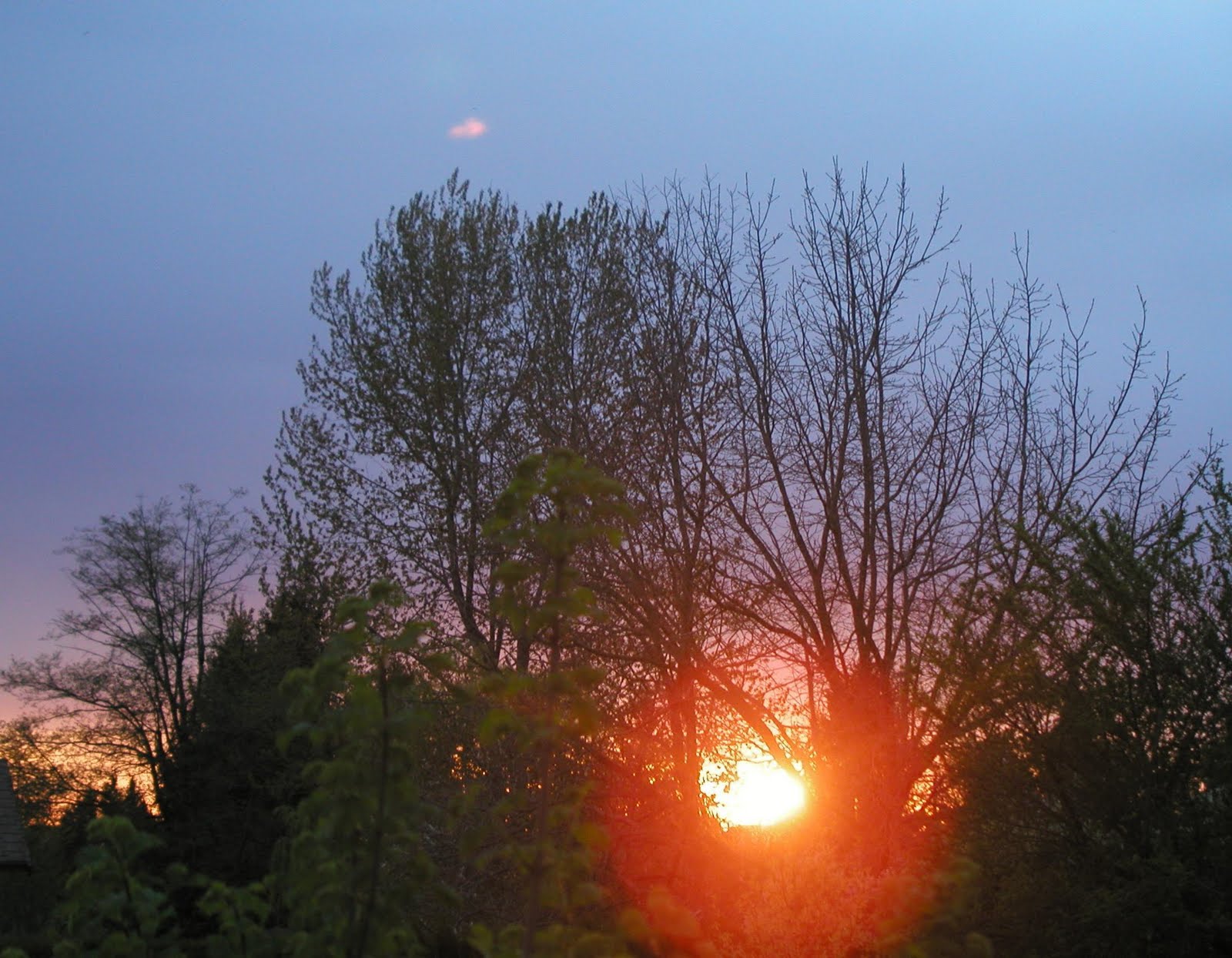
(Picture taken from a number of days ago)
Today I realized I may have seeded too much lettuce and cabbage in the greenhouse. But I am not panicking.
Today was a half day at work.
Today a Japanese heavy-duty mechanic by the name of Thomas was, to my guessing, learning the ropes at an organic farm in the Yukon and servicing all their equipment for free. Before he left for the Yukon by automobile he said to me, smiling, "If you need my help just dial 555-5555, and say, 'Thomas-Come-Help-Me!'"
Today I slept an hour before evening, which I hate doing; but I couldn't help it.
Today the lingonberry blossoms, apple blossoms and lilac blossoms studded the rainy gloom in full or near prime.
Today Prince Edward bought one of my paintings. It was, you might say, rather quite highly satisfying indeed.
Today all the other volcanoes networked via underground and said to one another, "Should we do it yet?" And a couple others chimed in that it wasn't their fault their bastard cousin jumped the gun.
Sunday, April 18, 2010
To be juried

Though it's still not finished, I will be entering the above painting (previous stage and previous stage) as it is (it has to be dry) into a spring art competition/exhibition being held at an art gallery that I hate. I will also enter in this one. Both are going to be frameless; I painted the canvas sides that wrap around the wood a dull red.
Hi Ho, Hi Ho
Week of work, would that you were already spent,
and some rest before me - leisure, art and friends!
My body and soul admit, one day of rest
is not enough; better we worked more like the French!
Or like the Spaniards with rhythm Siesta,
and countless others, like the natives in Australia
who spend a day to hunt and cook; their morrow cool,
not cause for panic, but like a storybook.
Jesus Himself in the dawn of His commissions,
laid down His orders mid the cooking of fishes
and bread - breakfast on a beach - God our age!
Prodded misery and gargantuan waste;
all present-tense; no tingling, not-yet-turned page!
People spend their lives without full earth's taste,
while falls the final play of a long, long jest:
how from birth, the damned New World never learned to rest.
Subscribe to:
Posts (Atom)