Showing posts with label Recipes. Show all posts

Sunday, March 24, 2019

The dried ones too


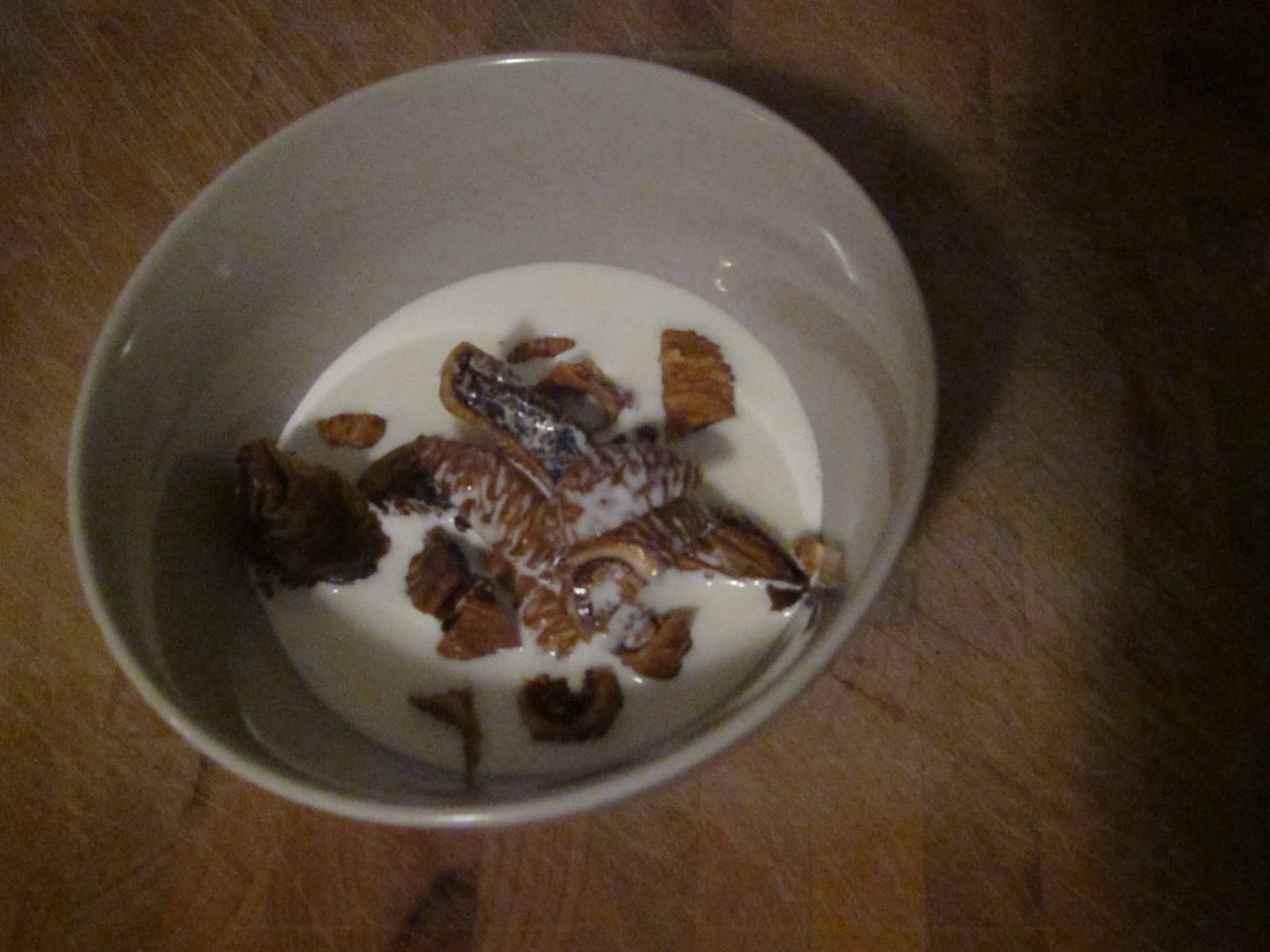
The dried Kalamatas are nice and chewy and have figgy depth. They soften nicely in the cream.

Having the dried figs in cream is a substitute for the absentee fresh ones that I grow on the - thus far - five trees. They give tons of figs, and I'm a big dumb weakling when it comes to giving them away. I like doing that - that is, to people who actually like them. Still, I keep a ton in the freezer, but they don't last long. They all get consumed by about - what is it - the end of October? But at some point in winter, their memory begins to haunt me, and I resort to store-bought dried figs.

The dried ones with viable seeds are a completely different fig from the fresh. I like the fresh best.

At the same "farmer's market" store down from where I live that I buy the dried figs, they had "fresh" figs one time - from Brazil - and I bought two just to see how they compare with the ones I grow.

I must tell about those figs from Brazil. They were so insipid it was like eating snot. If that is people's experience of figs, then no wonder people say they're not fans. Not that I was surprised, though it did make me happy to know that the figs from the trees I grow are so superior in sweetness, flavour, texture, etc. that there is simply no comparing. I'm not tooting my own horn - I don't "grow" them - the trees grow them with the aid of light and water and heat and such. I merely tend. And talk to them.

I understand that they pick the figs before they have properly ripened, and figs do not ripen off the tree. All for the sake of shelf life, and shipping life. I'm guessing that they also "force" the figs by over-watering to make them super plump, which waters down the flavour (kind of like anti-Francis Super Catholics ginning up the culture of appearances). Picking figs before they have ripened is a crime. I committed this offense so many times - picking some of the first ripening figs too early - that it was only by having my own stupidity shoved in my face after something like the fourth year that I began to learn the art of long-drawn detachment that fig trees demand.

Did you know that someone under a fig tree is a symbol of prayer?

Thursday, August 17, 2017

Simple


Take fresh figs and put them in the freezer.

When fully frozen, take four or so out and peel/shave off skin with knife. You can peel them before putting them in the freezer too. Doesn't matter which way. (I don't mind the skin when they're fresh, but somehow the skins when frozen bring a little bit of salty/savoury/vegetal flavour to this dessert, which isn't ideal. It's not huge; having the skins on won't ruin it, but it's there when you eat the skins.)

Cut them up and put them in a bowl.


 Pour in half and half cream. Or full cream - doesn't matter.


Do not eat it right away. Anyway you can't, because when the cream goes in, all the frozen fig pieces freeze together as one mass. Let it sit. Then start stirring it around with your spoon, mashing up the fig pieces a little. How far you want to go in melding the cream and frozen figs is up to you. It becomes a wonderful soft ice cream/milkshake bubbly type of thing. Do not add sugar or honey. It doesn't need sweetening.

You could sell this in a restaurant.

Friday, March 20, 2015

Bread in a pot


Well that turned out well. At least as far as looks are concerned. As for taste, we have yet to see.

Monday, February 14, 2011

Honey Cookies

I couldn't find the recipe I used the last time I made honey cookies. I searched a little on the internet and found this one. It's similar to the ones I made last time - a cake-like cookie. But these ones are too sweet for me. The last ones I made were almost like a biscotti, sweetness-wise (though of course not texture-wise).

This recipe calls for 1 cup of honey and 1 cup of sugar. I did 1 1/2 cups of honey and 1/4 cup of sugar. I could have cut out the sugar entirely. I also lowered the baking temperature to 325 F, as honey has a lower cooking point than sugar.

I also should not have used shortening as the recipe calls for, but butter. You cannot beat real butter. I used the shortening because we happened to have some in the house. It also doesn't help that the recipe calls for it - though I'm not sure "old German" honey cookies would have been made with shortening.

I did not know that St. Valentine is a patron saint of beekeepers. I discovered it at Fr. Z's. It's fitting I guess that I decided to make honey cookies then.

For some reason the camera makes the lighting a sort of yellowy sickly hue in some of the photos. I figured I would just put the pictures up in no particular order.


Found the organic flour on sale. I know, time to phone Poison Control.


It just has absolutely nothing on butter.


I bought a tub of the stuff some time ago that I've been working through. I use it often in coffee. I like the fact that it has pieces of bees wings in it. You can see pollen on the lid:


Thursday, December 30, 2010

Christstollen, step whatever

So there's the dough, doubled in bulk after two hours:


What, am I going to give away all the secrets? Okay, the recipe is largely from inmamaskitchen.com. But there are my own variations brought to it, and which I will hopefully develop further. Spread the flour out on your kneading surface:


Punch down the dough:


Now comes probably the most difficult part of the entire process - kneading the fruit mixture into the dough:


The difficulty is twofold. First, it requires lots of labour simply to get all the fruit kneaded into the dough - which requires three hands. Second, you must knead the dough as little as possible while carrying out the above. It would be relatively carefree if one could knead the dough for however long one wanted to get all the fruit in there; but do it too long and the dough will go "grey".


Molly likes raisins that have been soaked in rum by the way.


Some smaller loaves and some bigger ones is good. Don't muck around trying size them up equally.

Grease baking sheets with butter:


Each part of the dough that has been cut (the six pieces) gets rolled to a slightly oval shape, then folded lengthwise - but the edge of the fold you are bringing over top doesn't line up exactly with the other edge. It stays about an inch or so within. The ends are pinched, and some pinching goes along the entire edge.

You put your loaves onto the greased baking sheets and brush them with clarified butter:


The clarified butter goes on the loaves before they get baked and after they are baked, just as they have come out of the oven. You want to clarify the butter first because it cooks better that way, and because with the milk solids gone it won't go rancid. Of course, even if one used butter without clarifying it, it would take a long while for it to go rancid - I would think longer than the shelf-life of the breads. But who knows. Clarified butter is just good in many ways for this type of use.

Then the loaves get covered and are allowed to rise for something like 45 minutes to an hour. It is double-risen bread.


And of course, after all that, you better watch those loaves in the oven like a hawk and not let them over-bake. Keep an eye on the undersides as well as the tops.


Dust with icing sugar after they've cooled. You'll need to dust them later as well, maybe several times, if you want the white.


Alright, all this baking blogging makes me feel weird now, and I probably won't be doing it ever again, or for a long while, but then again, this blog is mostly just about filling in the gaps with stuff. Eclectic is my middle name.

Tuesday, December 28, 2010

Christstollen, step 2


So I left the peels to firm up over a couple of days, just with some wax paper lightly placed over top.

Then I picked a day, a couple days before I made the stollen dough, to mix all the citrus, raisins, almond slices and currants together. I cut up the citrus:


And mixed everything.


Something about the dried currants. I bought a bag of them from the grocery store. The bag said "Currants", but I did not pay attention to the words beneath it that said: "Raisins de corinthe". When I ate some of the dried "currants" upon opening the bag, they tasted just like raisins - just smaller. The use here of "Currant" is some corruption, presumably by the French, which they use for a different kind of grape. This pissed me off a little. No matter. To me there just has to be currants - the real black currants - in stollen. No matter, there were simply more raisins. No major harm done.

What you do is take some rum,


and do the right thing:


Some say do this a few hours before making the dough, some say over night. I say a good couple days - and after the first day, pour a little more rum into the mixture, and some more the next day, and a little the day you make the dough. Of course, throughout the days, you want to be mixing the stuff around on occasion. There ought to be some rum left over in the bowl after the mixture is drained. It was not so this time around. For all the rum I poured in, the mixture absorbed it like a sponge.

It's good to have leftover rum that doesn't get absorbed because it goes into the milk which you scald for making the dough.

Monday, December 27, 2010

Christstollen, step 1

Make the candied citrus peels. I used approximately a dozen lemons and ten oranges. I got the simple recipe from Market Manila, a very nice food blog.


For the lemon peels I made a 2 cups water to 2 cups sugar ratio. The same also for the orange peels. This was the first time for me making candied citrus peel. Last year when I made stollen (for the first), I bought the candied citrus from the store. I won't be buying it from the store any longer.

Getting these,


is very simple. So what that it is time-consuming? It's a rather leisurely process. (Those bowls behind the trays are holding the leftover syrup, which one shouldn't throw away as they are flavoured with the citrus, and can be used for other things.)

Tuesday, December 29, 2009

Christstollen


I made stollen (German Christmas bread) for the first time on Christmas Eve. It turned out excellent. I love the fact that you soak the candied fruits (cherry, citron, dried currants, almond slices, sultana and golden raisins) in dark rum overnight. I put marzipan in the center of three of them.

I can eat fruit cake; I can appreciate it, but typically it's just too overbearing. Stollen though is pitch perfect; more evocative than those hefty fruit bricks. Is it cake or is it bread? I guess one would call it a sweet bread.

Friday, February 27, 2009

Do you know how to program a compu--//**^^..>>]-]-b-bake bread?

"It was always cold in the house...'cause they didn't want to use up what they had in case it got colder. We'd be all dressed up sitting there by this little stove...but my mother used to bake bread in that stove, and the bread was just delicious. Everything was terrible but we had good food."

I'm sure that in an economic crash people who know nothing of food preparation and cooking would be forced to discover how to cook basic good food. Nonetheless, one may find it interesting and worthwhile to watch someone who has actually been through the Great Depression cook food. Apparently Clara Cannuciari's Great Depression Cooking with Clara videos are quite popular. I've only found out about them today. She also talks about her experiences somewhat in her videos.

Her site can be found here. Her youtube videos can be found at that site, under the "episodes" category.

Hat tip to Spirit Daily.

Sunday, December 28, 2008

A recipe

A common, well-known, down-home recipe.

Great for those cozy winter nights by the fire.

Saturday, October 4, 2008

Leeks

Yesterday, a desire for leek soup came out of nowhere. I searched and found this person's recipe.

The taste is delicious as the soup is simple. I got my mom to make it that evening and I helped. You can use half-and-half cream instead of heavy cream. And we found you don't need to mash the potatoes.

I had a friend in my teen days whose English parents made leek soup from the leeks in their garden. If I remember right, leeks will stay in the garden for a while into late fall, maybe even winter. They are perfect for soups for those cooler gusty darkening days.

I can see this soup going better with sourdough than with french bread. I can also envision this going well with fried crumbled bacon sprinkled on top. Then, with some red wine (in a tumbler, not a long stem) you're all set.

Make it a double recipe and put some in the fridge in jars for it tastes even better reheated later.