Showing posts with label Foraging. Show all posts
Wednesday, January 17, 2018
The best apple I have ever eaten
Or the best apple I ever ate.
Both sentences are legitimate and perfectly viable English grammar. The only arguable part is the word "ever". For it may not be "ever". We need to cut back on "ever". (Just like we need to cut back on "beyond".) Only if I died tomorrow would the sentence be true with "ever", for tomorrow - and tomorrow, and tomorrow - I could, and hope to, eat an apple yet that will take the title "best".
For there are many apples, and many apples I have not eaten or ate (I love how you southerners say ate instead of eaten - it's perfectly excellent grammar). I'm just a newbie when it comes to knowing the tastes and textures of the vast array of apples. And further, apples do not differ from each other in the way that - say, mangoes differ from each other. Certain apples can take on such a distinctive profile as to induce this commonly known phrase among pomologists: "If you were to eat this blindfolded, you would not know that it was an apple." For this reason you would not be far amiss to say that apples are the most universal fruit.
The two apples in the picture are not, and yet are, the apple I am referring to when I say, "The best apple I have ever eaten." For those are apples from the tree from which I had the best apple I ever ate, but neither of them are the apple. That picture was taken 2015. The best apple I ever ate was one from the same tree only last year, 2017.
I do not know the variety of this apple tree. It grows by a horse trail. The two apples in my hand were picked, and just under ripe. No matter. When they are not quite peaked in ripeness they are intense. Have one and your mouth goes raw. Have two and your stomach lining is in a questionable state. Of course I ate both, one after the other, for they are complex - intensely sweet and intensely...sour? I don't like using the word sour in this case, because sour too often refers to something that has spoiled, like sour milk. Anyways, the rawnesss of both mouth and stomach didn't last long - it's no matter to me. Many wimps today with overly domesticated palettes would not be able to get past one bite.
But when they ripen to full peak - now that is what I'm getting at here. The best apple I ever ate had fallen from the tree. It was lying by the trail in dusty grass, just a few feet away from a pile of horse dung. I wiped the dust off the best I could on my shirt and took a bite.
I wouldn't know how to describe it. Champagne? But I'm not a fan of champagne. I don't know. It was amazing. Just in case you might be thinking, "Ah, Paul, the apple was starting to ferment" - no, it wasn't. It was perfectly ripe, nowhere near overripe. The burst of sharp intensity, the warmth of it - not just the warmth of the apple basking in the sun, but the warmth of the flavour. It was a taste that completely filled the mouth, exuberant, superabundant.
The knowledge that we have of apples according to what we get from the supermarkets is impoverished, to say the least.
Just like our notion of heaven.
Monday, July 17, 2017
I'm your hucklebearer
Monday, May 19, 2014
Mole and Leaf
Dug up a live mole in the garden. After turning over a wad of earth he was just sitting there. The plump little fella played dead, until I tried scooping him up with the spade. Then he burrowed back into the earth. I had never seen a mole in the act of digging before. Moles can burrow into the earth like the Dickens.
Like the Dickens.
I could not concede to killing him, though all what it would have taken was a quick splice with the spade and it would have been lights out for Mr. Mole. Or - since it's a mole - would that be lights on?
This dried leaf,
was a leaf I took from the forest - in order to dry it.
Why? Because when you dry this leaf from the forest it makes a smell.
What does it smell like? I would describe it if I could. But I can't, so I won't.
That's all.
Like the Dickens.
I could not concede to killing him, though all what it would have taken was a quick splice with the spade and it would have been lights out for Mr. Mole. Or - since it's a mole - would that be lights on?
This dried leaf,
was a leaf I took from the forest - in order to dry it.
Why? Because when you dry this leaf from the forest it makes a smell.
What does it smell like? I would describe it if I could. But I can't, so I won't.
That's all.
Friday, May 2, 2014
Sunday, April 27, 2014
Walk
Wednesday, March 5, 2014
Monday, July 1, 2013
Friday, April 19, 2013
More Mate
All that put me in mind of this Eat the Weeds video on the holly, which is the family that Mate comes from.
Deane teaches you can use some of the specimens to make mate:
Friday, July 8, 2011
Garden Sprawl Friday
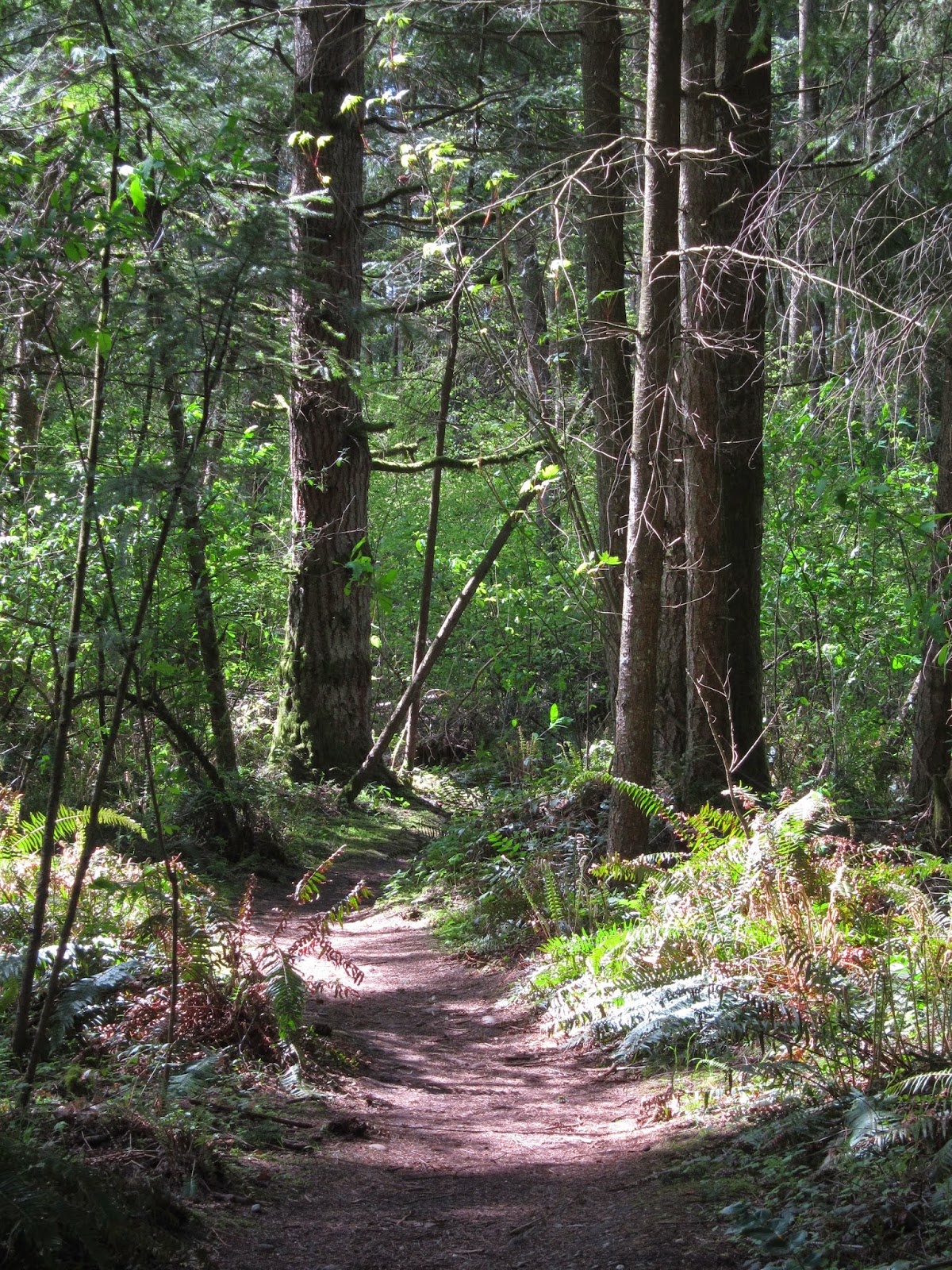
Been some while since having a GSF post, and figure starting them again away from the backyard and into the forest - the effortless garden - would be good, as I went there this evening.
There are five berries that I know of in these woods to forage: red huckleberry, osoberry, thimbleberry, salmon berry and blackberry. Salmon berry ripens first. They come in either pale yellow or dark red. Their taste tends to the insipid side, but are somehow still juicy and refreshing. This year there are lots of them and they're big and juicier than usual.
The osoberry is close behind salmon berry in ripening, suddenly all of them at once, and the red huckleberries ripen at the same time, but not all at once. Then the thimbleberries, with just a few fully ripened at this time. Blackberries don't ripen until later in summer.
The osoberry, or Indian plum:
The skin of them is thin and they want to stain your hands. They have pits and there is not a whole lot of meat, but they are very unique, and I find, pleasant in their taste. Some people say they taste like a cross between a blueberry and an olive. Honestly, I cannot think of a closer comparison.
They grow all over the woods in thickets. They hang in clusters that you pick entire as you walk by and eat them and spit out pits as you walk through the woods, until you come across another thicket and take another cluster, and so on.
The red huckleberry:
This one is my favourite. I like the green of the bush; I like how, with a few exceptions, it only grows out of rotting douglas fir stumps, or occasionally the base of living ones; I like the zingy, tart-sweet taste of the berries; I like the taste of its leaves, which I eat sometimes along with the berries.
The thimbleberry:
While the red huckleberry is my favourite all around, the thimbleberry is undeniably the richest in flavour. The taste to me is like a rich jam. The berries just melt in your mouth with a deep warm flavour. And not surprisingly, it is used to make prized jams, by people who jealously guard the secrets of their thimbleberry locations. There really is no need for that where I live, it's so common. Although the plant does have to have a prime location to make berries at their tastiest best.
One nice thing about picking the thimbleberry, as with all the other berries above, is that though it grows in thickets, they do not cut you apart like blackberries. In fact, the leaves feel like velvet - no exaggeration. And therein is a useful piece of information. I don't speak from experience, but it's common lore among wildcrafters that in case you are ever in the wild in those areas of North America where thimbleberry grows and you have to, uhm, you know, and then you have to, well, you know, then you can use the leaves for...you know. Anyhow! Of course with all berries, the ones that get the most light as well as adequate wet are the best tasting.
Labels:
Foraging,
Garden Sprawl Friday,
Redwood Park
Monday, December 13, 2010
Subscribe to:
Posts (Atom)